Keep your cameras
You already bought the cameras.
We're the brain behind them.
Most security companies want you to rip out what you've got and start again on their hardware, their app, their lock-in. Sentry doesn't. It plugs into the cameras already on your home, and adds the one thing the camera vendor never built: a layer that actually understands what it's seeing. Keep the hardware. Add the intelligence.
Register interest · tell us your cameras
Type your camera brand to register interest in the Sentry beta. We'll tell you straight where it stands, whether ready for the closed beta, still in pilot, or needs one small entry camera, and put you on the early-access list. What you tell us here decides where Sentry rolls out first. Nothing to pay.
A small Vigil Guard bridge on your home network reads supported cameras directly, nothing for the camera vendor to approve. Cloud-sealed brands (Ring, Nest, Arlo, Wyze, Eufy) can't be tapped by anyone, so those homes get one Vigil Guard-supplied entry camera instead.
Brand names are the property of their respective owners and don't imply partnership.
How Sentry sees
Three tiers, in plain English.
Every camera clip Sentry analyses lands in one of three buckets. The bucket decides what happens next. Most of what your cameras catch is a possum, the postie, or your own kids. Sentry knows that, and stays out of your way until something actually warrants your attention.
Quiet, filed, scrollable.
Sentry sees something worth remembering but not worth waking you. The clip lands in your app's daily feed, with a one-line summary of what it saw.
- Same unknown person past your house ≥3 times in 7 days
- Stranger approaches the door, then turns and leaves
- An unfamiliar car circling the block after dark
- Someone lingering at the gate longer than a delivery
Wakes you, instantly.
Sentry sees something that warrants your eyes now. You get a push alert in seconds, with the clip and a one-line summary of what it saw. You decide whether to escalate it to a full panic alert.
- Fence-climbing or perimeter breach
- Forced-entry attempt at a gate, door or window
- Masked face approaching the entry point
- Prolonged tampering with a lock or window frame
The moment the cameras were bought for.
Sentry sees an in-progress incident. Tier III is built to fire your panic alert, and through closed beta it asks you to confirm first. That alert reaches your four emergency contacts on a parallel call tree, plus your street network with the approximate area, your four contacts with live GPS attached. You can stand it down from your phone. In a life-threatening emergency, call 000.
- Successful intrusion past the property line
- Multiple offenders inside the perimeter
- Visible violent contact with an occupant
Tier III auto-alert is in closed-beta tuning. Until the measured false-positive rate is below one in ten thousand motion events, Sentry asks you to confirm before firing the panic network. Vigil Guard never dials 000; it alerts your contacts and your street.
Tested on real footage
We ran Sentry against fifty real CCTV frames. Here's the scorecard.
Most AI security pitches show you a demo. We're showing you the audit. Fifty real residential CCTV and doorbell-camera stills, from deliveries, posties, possums, an actual vehicle ramming a residential gate, fed through the same two-stage Claude pipeline that runs in production. Every verdict logged. No cherry-picking.
Numbers are direct from the May 2026 validation run: fifty real CCTV frames, hand-labelled, scored against the two-stage Haiku 4.5 → Sonnet 4.6 pipeline that powers production. Of the forty-six quiet residential scenes (deliveries, posties, residents coming home), Sentry correctly filed forty-four to the app feed without waking anyone. Full per-frame verdicts available on request at luigi@vigilguard.com.au.
Two real verdicts, verbatim.
No paraphrasing. These are the actual JSON responses the model returned, copied from the validation log.
Daylight residential doorstep. A figure walks up carrying a small parcel, places it down, walks back.
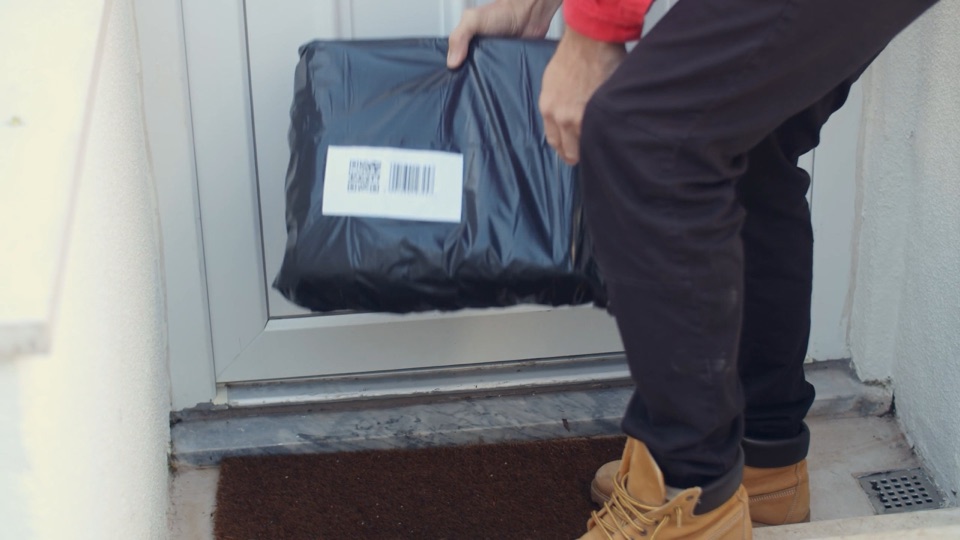
Source: Pexels video 6667264 (free Pexels licence).
"A delivery driver is placing a parcel with a barcode label at the front door: standard residential delivery behaviour over approximately 25 seconds."
Above the 0.90 confidence gate, Sentry accepts Stage 1 and files the clip quietly to the app feed. No notification. No operator pinged. Stage 2 not invoked. Cost: $0.006.
A car has rammed through the entry gate of a residential property. The hardest call in the corpus, and the case the two-stage design exists to catch.
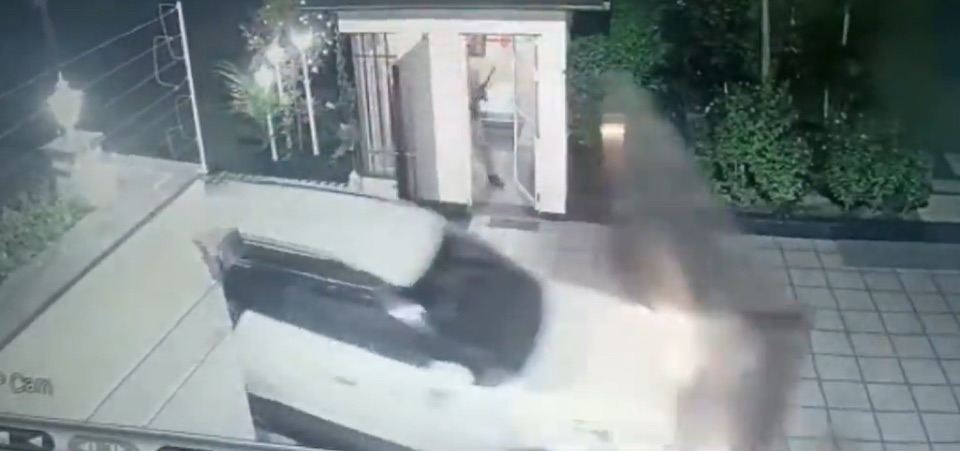
Source: Wikimedia Commons, Public Domain.
"A parked vehicle in the driveway during daylight hours with no signs of tampering, forced entry, or suspicious activity."
Stage 1 mis-read it. Confidence 0.85 is below the 0.90 gate, so it automatically escalates to Stage 2.
"A vehicle appears to have rammed or is actively ramming through the property entrance gate at night, constituting a successful forced intrusion with a motor vehicle."
Final verdict: Tier III. Recovered by the second model. This is the kind of frame that fires your panic network: contacts alerted with your live location, street with the approximate area. It is the exact failure-mode two-stage exists to prevent, and the reason a Tier III candidate is never trusted to a single model.
What we still need: more real Tier III footage. The audit above contains one Tier III frame, sourced from public-domain footage. We want one hundred before locking the production false-positive gate. Founding-cohort cameras feed that corpus, anonymised. Until that body of evidence exists, Sentry asks you to confirm before it fires the panic network. More on that.
How it works
Your camera. Our AI. Your call.
Sentry doesn't ship you another camera if you already run UniFi. It reads the cameras you've got, through a small Vigil Guard bridge we set up for you, and adds the part the camera vendor never built: the layer that actually understands what it's seeing. No UniFi system? Tell us when you register interest and we'll work out the entry-camera path with you before the beta opens.
Camera detects motion
Your existing camera fires its onboard motion sensor, exactly like it does today. A 30-second clip is captured locally on a small Vigil Guard bridge agent at your home.
Clip uploads · masked zones ignored
The clip is sent encrypted to our cloud. The public footpath, your neighbour's driveway, anywhere you've marked: Sentry never sees, never analyses, never stores.
Claude AI analyses the frames
Anthropic's Claude vision model reads the clip in seconds. It writes a one-paragraph plain-English summary of what it sees, and assigns a tier with a confidence score.
Tier decides what happens
Tier I files quietly. Tier II wakes you. Tier III is built to fire your panic alert (confirm-first through closed beta): your four contacts with your live location, plus your street network with the approximate area.
Privacy by design
The footage is yours.
Sentry processes video of identifiable people. We treat that with the seriousness Australian law requires: under the Privacy Act 1988 (Cth), the Surveillance Devices Act 1999 (Vic), and the Australian Privacy Principles. Plain English version below.
- Opt-in only
- Sentry never analyses a camera you haven't explicitly enrolled. No background scans, no auto-discovery, no "free trial" you didn't ask for.
- Mask zones you control
- Before Sentry analyses your first clip, you draw the zones it must ignore: the public footpath, the neighbour's yard, anywhere outside your boundary. The AI is given the masks before every frame. Masked regions never enter the model.
- Retention you decide
- Default thirty days. You can set it as low as seven days or as high as ninety. After retention expires, clips are deleted from our storage and from our backups. You can also delete any individual clip immediately from the app.
- Audit log
- Every clip Sentry analysed, every tier it assigned, every action that fired off the back of it: logged in an append-only audit trail you can request a full copy of, any time.
- Deletion on request
- Email luigi@vigilguard.com.au and we erase every piece of footage and metadata we hold on you within seventy-two hours. We send you the audit log of the deletion as proof.
- Anthropic stewardship
- The AI that reads your clips is Anthropic's Claude. Anthropic's enterprise terms forbid training on our customers' data. Your footage trains nothing.
- Australian-hosted
- Clips are stored at rest in the Sydney AWS region. They never leave Australia, except for the millisecond-long round trip to Anthropic's API to be analysed, after which only the AI's text summary is retained, never the raw frames.
One of five pillars
Sentry guards the home. The rest guard the street and the walk.
One tap flags suspicious behaviour, never appearance. Members vouch for real residents on their street, building a verified constellation of trusted neighbours so the network is harder to spoof.
Hold three seconds. It alerts your four emergency contacts with your live location and your street network with the approximate area. You call 000 yourself; Vigil Guard never dials it.
A licensed operator runs a logged, GPS-stamped slow-pass dusk to dawn once enough neighbours on a street join. It begins state by state where Vigil Guard is licensed.
The on-the-move layer. Set an ETA for a watched walk home; miss your check-in and your contacts and street get your last location. Steady stays with you in calm stages when you feel followed, and can fire the panic alert.
Questions worth asking
Things people actually ask.
If your question isn't here, email luigi@vigilguard.com.au and a founder answers. We add the recurring ones back into this list.
When does Sentry fire an alert on its own?
Tier III auto-alert is in closed-beta tuning. Until the measured false-positive rate sits below one in ten thousand motion events, Sentry asks you to confirm before it fires. When it does fire, it alerts your four emergency contacts through a parallel call tree and lights up your street network, all with your live GPS attached. Sentry never dials 000; it alerts your contacts and your street, and you call 000 in a life-threatening emergency.
What cameras work with Sentry?
Closed-beta ready: UniFi Protect (G3/G4/G5), proven end to end. In pilot validation: Reolink and other RTSP-capable IP cameras, rolling out to founding-cohort homes as each is verified on real footage. Cloud-sealed brands (Ring, Nest, Arlo, Wyze, Eufy) can't be read by anyone, so those homes get one Vigil Guard-supplied entry camera instead. A small Vigil Guard bridge on your local network does the motion capture, and we set it up for you.
What happens when Sentry gets it wrong?
Tier I false positives sit in your app feed. You scroll past and tap "dismiss", and the system learns. Tier II false positives wake you; you stand them down with one tap and the clip is tagged. Nothing escalates to your panic network unless you choose it, or until Tier III auto-alert clears its false-positive gate. We publish quarterly calibration data, false-positive rate by tier, once the founding-pilot baseline has thirty days of real footage.
How accurate is the AI?
On the May 2026 validation run of fifty real CCTV frames, hand-labelled, the two-stage Haiku 4.5 → Sonnet 4.6 pipeline scored 92% accuracy with zero malformed verdicts, at an average cost of $0.019 per clip. The two-stage gate is the reason: any clip Stage 1 isn't confident about (below 0.90) is automatically escalated to Sonnet, which is what recovered the vehicle-ramming-gate frame Stage 1 initially mis-read. See the scorecard for the full per-frame numbers and two verbatim verdicts.
Who can see my footage?
No human watches your Tier I footage. Those clips file straight to your app feed and stay yours. You control who sees a clip: it lives in your app, and you choose whether to share one with a contact or attach it to a panic alert. Masked regions you've drawn (footpath, neighbour's yard, anywhere outside your boundary) are painted black before any clip renders, so they never appear to anyone, including the AI.
Does my camera footage train AI?
No. The vision model is Anthropic's Claude. Anthropic's enterprise terms forbid training on customer data, and we have no other ML pipeline. If we ever change this we tell every member thirty days before in writing, with a full refund window.
Where are the clips stored, and for how long?
Australian-hosted: clips at rest in the Sydney region. They never leave Australia except for the millisecond round-trip to Anthropic's API for analysis. After that, only the AI's text summary is retained, never the raw frames. Default retention thirty days. You can set it as low as seven or as high as ninety from the member app. Deletion on request: email luigi@vigilguard.com.au, full erasure within seventy-two hours plus a written audit log proving it.
How does this compare to a regular alarm-monitoring contract?
Alarm monitoring waits for a sensor to fire, then dispatches a guard. Sentry analyses the camera footage in real time, classifies what it sees, and tells you before any sensor would have noticed. Your existing alarm, and your existing 000, still work. Sentry adds a layer; it doesn't replace what's there. It's in closed beta and not on sale yet. When it opens, it'll be month-to-month with no lock-in.
Sentry · founding-cohort closed beta
Camera in. Sleep deeper.
Sentry isn't on sale yet. To register interest, tell us which cameras you own above, or leave your email here for a beta invite. The first fifty invites go to founding-cohort members in the three pilot postcodes, then expand.
No spam. We tell you when there's a slot. That's it.
Thank you. We'll be in touch when a slot opens.